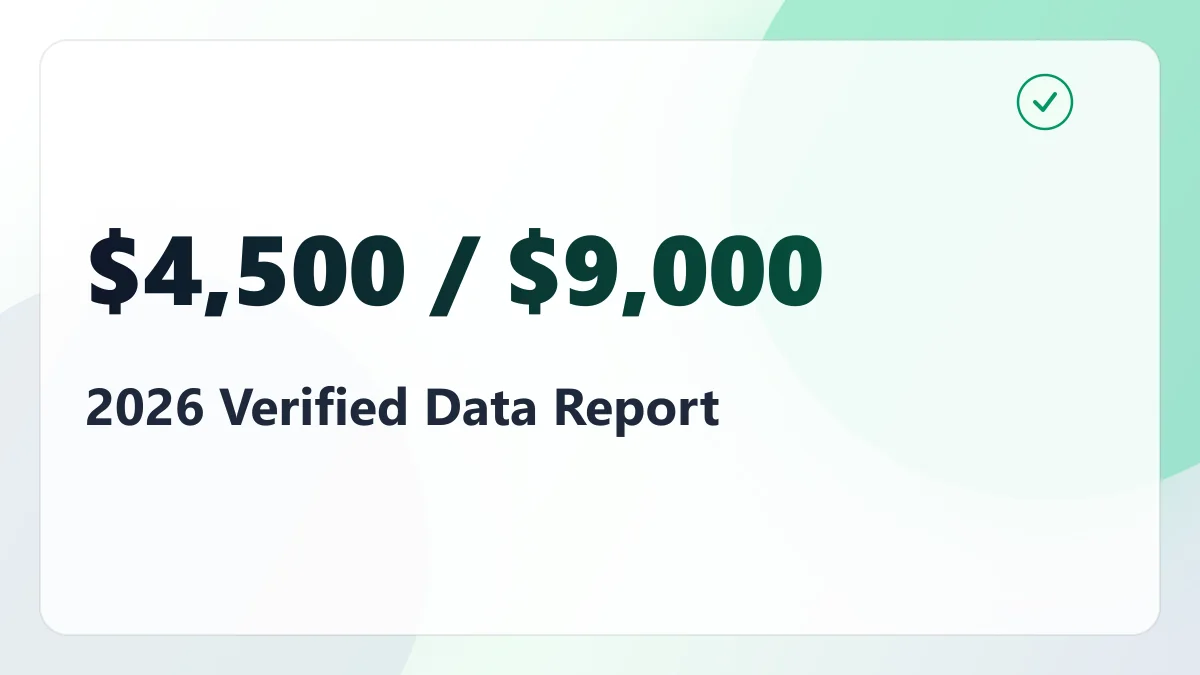
For 2027 you may put $4,500 into a health savings account with self-only coverage and $9,000 with family coverage (Rev. Proc. 2026-24). Those are the headline numbers, they are up modestly from 2026, and they are not the interesting part of the announcement.
Tax Disclaimer: This article covers the tax mechanics of a federal deduction and the statutory limits attached to it. It is for informational purposes only, is not tax, legal, financial or insurance advice, and does not recommend any health plan. Consult a qualified professional regarding your specific situation.
The Four Numbers That Define the Account
A health savings account is not a standalone product. It is a tax wrapper that only exists if the plan attached to it meets two statutory tests, so the limits come in two pairs rather than one.
For 2027, a qualifying high deductible health plan must carry a minimum annual deductible of $1,750 for self-only coverage and $3,500 for family coverage, and its maximum annual out-of-pocket may not exceed $8,700 self-only or $17,400 family (Rev. Proc. 2026-24).
The 2026 figures for the same four tests were a $1,700 self-only minimum deductible, $3,400 family, and out-of-pocket ceilings of $8,500 and $17,000 (Rev. Proc. 2025-19). Contribution limits for 2026 were $4,400 self-only and $8,750 family (Rev. Proc. 2025-19).
Which Direction Each Number Cuts
Read the two sets side by side and one asymmetry falls out.
| Self-only, year over year | 2026 | 2027 | Change |
|---|---|---|---|
| Most you may contribute | $4,400 | $4,500 | +$100 |
| Least the plan may deduct before paying | $1,700 | $1,750 | +$50 |
| Most the plan may take out of pocket | $8,500 | $8,700 | +$200 |
The shelter grew by $100. The exposure grew by $200. On family coverage the same comparison runs +$250 of contribution room against +$400 of out-of-pocket ceiling.
This is not a scandal, and it is not new. Both figures are indexed and they simply index off different bases. But it is the number worth carrying into a plan comparison, because the account’s tax benefit is capped by the smaller of the two and your worst year is bounded by the larger.
The gap between what you may shelter and what a qualifying plan may charge you is wider in 2027 than it was in 2026. Anyone choosing a high deductible plan mainly for the account attached to it should size that gap deliberately rather than assume the contribution limit describes the trade.
The Deduction Works Whether or Not You Itemize
This is the part that makes the account worth the paperwork, and the part most people underuse.
An HSA contribution you make yourself is deductible above the line. The IRS is explicit: “You can claim a tax deduction for contributions you or someone other than your employer make to your HSA even if you don’t itemize your deductions on Schedule A (Form 1040)” (IRS Publication 969). It does not compete with the standard deduction of $16,100 single or $32,200 married filing jointly. You take both.
Contributions routed through an employer’s cafeteria plan work differently and usually better. A salary reduction into an HSA through a cafeteria plan “are treated as employer contributions,” and employer contributions are not included in your income at all (IRS Publication 969). Income you never received is a cleaner outcome than income you received and then deducted.
If your employer offers the payroll route, that is the route. If you are self-employed and contributing directly, the deduction still lands, just on a different line.
Two Rules Worth Knowing Before November
The last-month rule. If you are an eligible individual on December 1, you are “considered an eligible individual for the entire year” and may contribute the full annual amount (IRS Publication 969). Enrolling in December does not restrict you to one twelfth of the limit. It does come with a testing period that can claw the benefit back if eligibility lapses, so read the rule before relying on it.
The deadline is the filing deadline, not December 31. Publication 969 puts the 2025 contribution deadline at April 15, 2026, which is the return due date rather than year end (IRS Publication 969). The same pattern applies each year. Deciding in April what you should have funded in January is a genuine option here, and it is one of very few deductions that still works that way. The same is true of the retirement contributions an extended return keeps open.
Why This Matters More If You Are Near a Credit Threshold
An above-the-line deduction reduces adjusted gross income, and adjusted gross income drives the household income figure used for the premium tax credit.
For a household sitting close to the ceiling on that credit, an HSA contribution is doing two jobs at once: cutting the tax on the income and cutting the income that the credit is measured against. We worked through where that ceiling sits for 2027 in the piece on the 400 percent line, and the same logic that makes a SEP-IRA useful there makes an HSA useful here. Size a retirement contribution alongside it in the Solo 401(k) and SEP calculator if you are self-employed, since the two stack.
What To Do Before Open Enrollment
Check whether the plans in front of you actually qualify. A plan with a deductible below the 2027 minimum does not support an HSA no matter what the enrollment portal implies, and the minimum for self-only coverage is $1,750 (Rev. Proc. 2026-24).
Then compare the out-of-pocket ceiling on each qualifying plan against the contribution room, not against the premium alone. Then check whether your employer offers a payroll route, because that changes the tax treatment rather than just the convenience.
If you are self-employed and near a credit threshold, run the contribution as an income-reduction decision rather than a savings decision, and size the rest of the year’s tax with the 1099 tax estimator before you commit the cash.
The Bottom Line
The 2027 contribution ceilings are $4,500 and $9,000, and the qualifying plan rules moved with them (Rev. Proc. 2026-24).
Take the announcement as two facts rather than one. The amount you may shelter rose. The amount a qualifying plan may charge you rose faster. Choose the plan on the second number and fund the account to the first.
