Three numbers from the last four weeks, before anyone interprets anything.
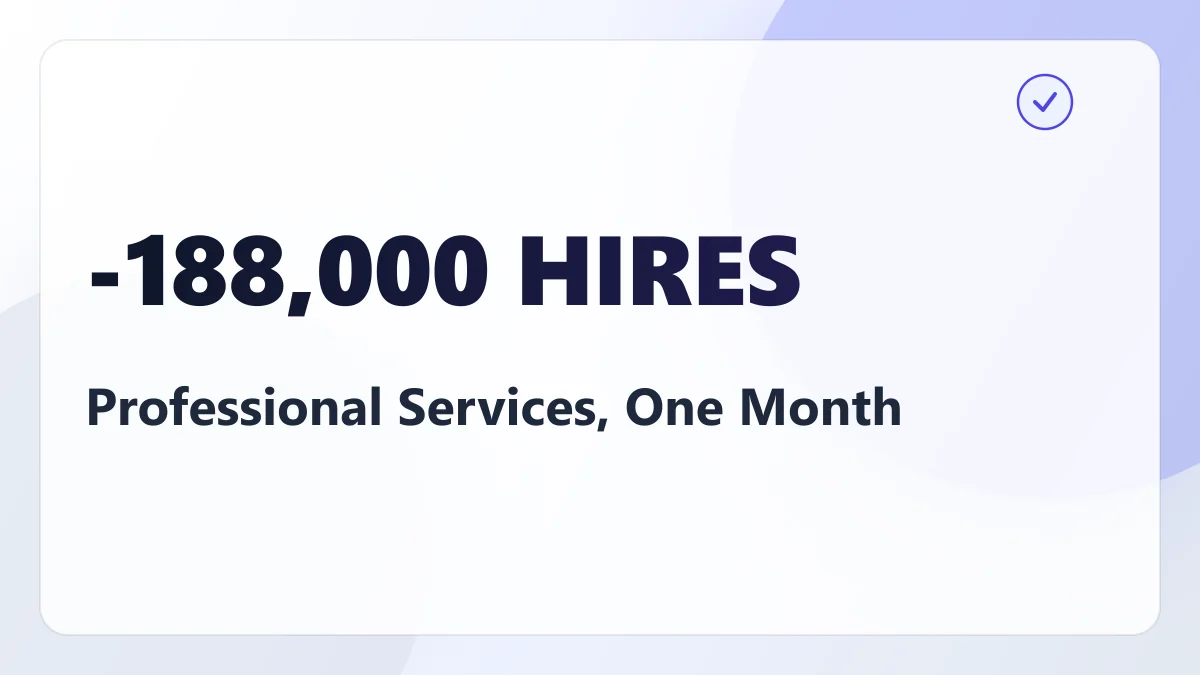
Hiring in professional and business services fell by 188,000 in July, the largest industry move in the report (JOLTS, September 1, 2026).
Nationally, the hires rate was 3.2%, against 3.9% in July 2019, while the job openings rate was 4.4% against 4.5%. Employers are advertising at 2019 levels and hiring well below them (JOLTS, September 1, 2026; JOLTS, September 10, 2019).
And the layoffs and discharges rate was 1.0%, below the 1.2% of July 2019 (JOLTS, September 1, 2026).
Now the interpretation, which most coverage of this gets wrong in one of two directions.
Both Popular Explanations Are Wrong
The first says AI is firing white-collar workers at scale. The layoff rate refutes it. Firms are separating from people less often than they did in a year everyone remembers as normal, and you cannot run a displacement wave at a below-2019 layoff rate.
The second says nothing unusual is happening and this is an ordinary cooling. The hiring rate refutes that. A 0.7 point drop in the hires rate at an unchanged openings rate is roughly 900,000 fewer people starting a job each month, and it is concentrated in exactly the sector where the tooling arrived first.
The mechanism sitting between those two positions is simpler than either: the adjustment is happening at the front door. Roles are not being eliminated, they are not being filled. A req that stays open for eleven months and quietly closes is a job that never existed as far as every statistic in this article is concerned, and it is the cheapest way for a firm to shrink without announcing anything.
What the AI Attribution Data Can and Cannot See
Artificial intelligence has now been the most common stated reason for announced US job cuts for five consecutive months, accounting for 112,713 cuts so far in 2026, about a quarter of the year’s total (Challenger, Gray & Christmas, August 6, 2026). We went through what that number is and is not in AI as the most common stated reason for job cuts.
Note what that measurement is: employers explaining announcements they chose to make. It counts people who were let go and a reason a press officer gave. There is no line item anywhere for a team that was going to add two analysts and added none, and that is now the larger number by a wide margin.
The people absorbing this shift are not in the layoff data because they were never hired. Challenger’s own report says as much about attribution being hard, and it is being honest. The instrument is pointed at the wrong door.
Challenger’s August report publishes tomorrow, Thursday September 3 at 5:30 a.m. Eastern (release calendar). It will tell you whether announced cuts rose. It will not tell you whether hiring resumed, and that is the number that has been moving.
What to Do About It This Week
If you are employed in a services firm, the useful signal is not your workload. It is whether the last three people who left your team were replaced. Two of three or better means the front door is still open where you are. Zero of three means your firm has already made the decision it has not announced, and your leverage is highest before that becomes visible.
If you are hiring, the arbitrage is real and it has a price. The candidates on the market in a 3.2% hiring economy include people who would not have been available at 3.9%, and the median time-to-accept falls with them. That advantage lasts exactly as long as the hiring rate stays down.
And if this puts you on the contractor side of the line, which is where a lot of displaced services work is landing, price it properly before you accept anything. A contract rate is not a salary divided by 2,080. You are carrying self-employment tax of 15.3%, the unpaid weeks between engagements, and every benefit that used to be someone else’s line item. The freelance rate calculator builds those in, and the 1099 tax estimator shows the bill when nobody is withholding for you.
The Bottom Line
The white-collar adjustment of 2026 is not showing up as mass firing, and everyone waiting for it to is watching the wrong instrument. It is showing up as 188,000 fewer hires in one sector in one month, at a national layoff rate below 2019’s.
Layoffs are visible, announced, and countable, which is why they get the coverage. A hire that never happens is none of those things, and it is where the change is actually occurring. The same pattern from the job seeker’s side is in more openings than 2019, 900,000 fewer hires a month.
