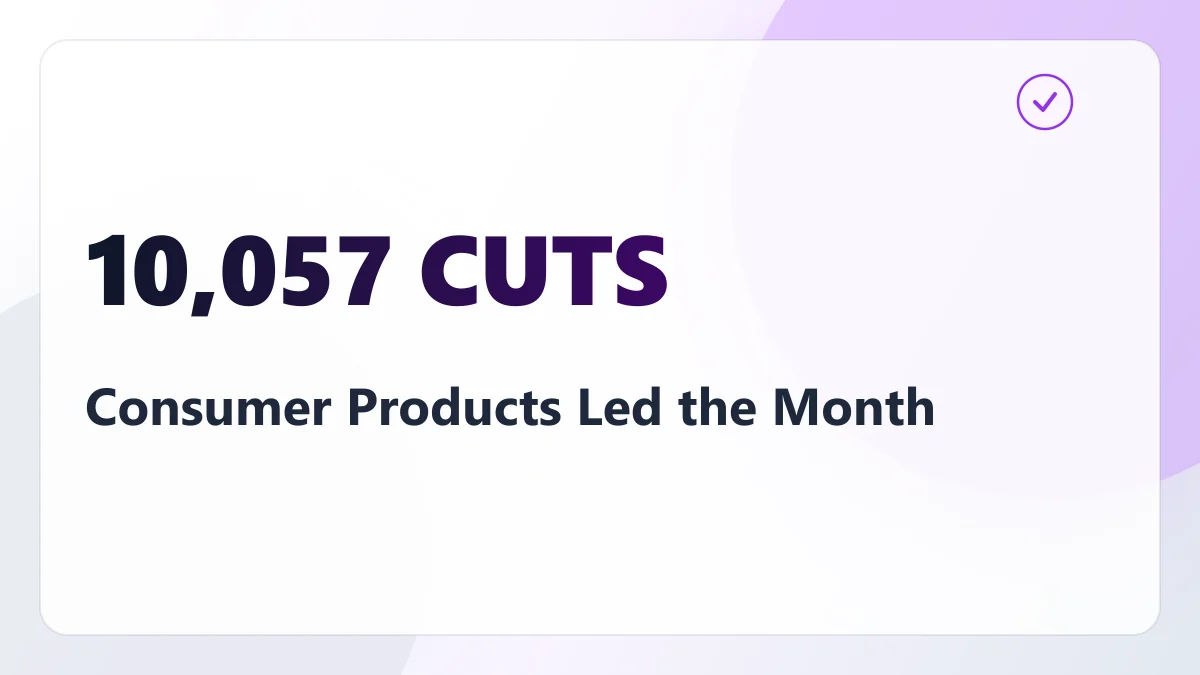
The industry that announced the most job cuts in the United States last month was not technology. It was consumer products, with 10,057, its heaviest month of the year, on announcements at Procter & Gamble and Estée Lauder. Food producers came second with 7,982. Technology came third with 6,103, its lowest monthly total of 2026 (Challenger, Gray & Christmas, September 3, 2026).
Total announcements for the month were 52,881, up 58% from July and down 38% from August last year (Challenger, Gray & Christmas, September 3, 2026).
The obvious headline is that the layoffs have moved out of tech. The year-to-date column says that is half wrong.
One month is not a rotation
| Sector | August 2026 | 2026 year to date | Same period 2025 |
|---|---|---|---|
| Technology | 6,103 | 155,126 | 102,239 |
| Consumer products | 10,057 | 28,574 | 35,641 |
| Food | 7,982 | 22,367 | 12,761 |
All figures from the August report (Challenger, Gray & Christmas, September 3, 2026).
Read the last two columns rather than the first. Technology is up 52% on the year against 2025 and remains, by a wide margin, the sector cutting hardest. Consumer products is down 20% on the year, so its record August is a spike inside a lighter year, not the start of something. Only food is doing both at once: a heavy month sitting on top of a year that is up 75% (Challenger, Gray & Christmas, September 3, 2026).
That is one genuine trend, one spike, and one sector having a good month inside a bad year. The tidy story about layoffs migrating from screens to shop floors is not in the data yet.
The hiring side has its own gap
Employers announced plans to hire 12,325 workers in August, up 725% from the 1,494 announced in August 2025, and 119,825 for the year to date against 87,626 through August last year (Challenger, Gray & Christmas, September 3, 2026).
Andy Challenger, the firm’s chief revenue officer, put the caveat on it himself: “This is the quietest August since 2022, but is generally on average for the month since the mid-2010s. What we’d like to see with low layoffs is an increase in hiring activity. While companies are making plans to hire more workers than last year, according to our numbers, it doesn’t appear those positions are being filled quickly” (Challenger, Gray & Christmas, September 3, 2026).
An announced plan is not a hire. The federal turnover data has been saying the same thing in a different vocabulary all year, and we put numbers on the distance between the two in more open jobs than in 2019, 900,000 fewer hires a month.
What actually changes with the sector, and it is not the reason column
Restructuring led all reasons for cuts in August with 16,173, or 31% of the month, and closings accounted for 6,743 (Challenger, Gray & Christmas, September 3, 2026).
That gap between a restructuring and a closing is worth more to you than any sector label, because the law keys on shape rather than industry. The WARN Act turns on how many people lose work at a single site inside a 30-day window, not on whether the site makes shampoo or software. Where it applies, it requires 60 days of advance written notice from employers with 100 or more full-time workers.
A plant that closes tends to meet that test easily. A percentage trimmed evenly across a company’s offices often does not, even when the headcount is larger. If your notice arrived this week, the thresholds and the exceptions are laid out in severance, COBRA and unemployment after a 2026 layoff.
The money is the same in every industry
Three things behave identically whether the cut came from a food plant or a product team, and all three surprise people.
Severance is wages. Paid as a separate lump, it is commonly withheld at the flat supplemental rate of 22%, which is a withholding convention rather than the tax you owe. If your marginal rate is higher, the shortfall shows up next April. Put your own numbers through the severance runway calculator before you plan around the gross figure.
Unemployment benefits are taxable income, and states do not withhold from them unless you ask. We wrote up the election and the arithmetic in why your unemployment benefits are a tax bill in waiting.
Benefits also run out faster than the search does. Maximum durations vary from 12 weeks to 30 across the states in our data, which is a difference of more than four months of income for the same job loss (state-by-state durations).
And if the severance lands as a lump this quarter, it can push you into an estimated-tax payment you have never had to make before, with the next deadline on September 15. The mechanics are in what to do when a windfall lands in Q3.
August was a month in which the cutting rose, the sector mix looked new, and almost none of it was the thing the year is actually made of. If you are reading it to decide whether your own industry is safe, you are reading it for something it cannot tell you. Read it instead as a reminder that the paperwork you get in the first week, the notice period, the severance schedule, the benefit claim, is where the recoverable money is. That part is under your control. The sector ranking never was.
