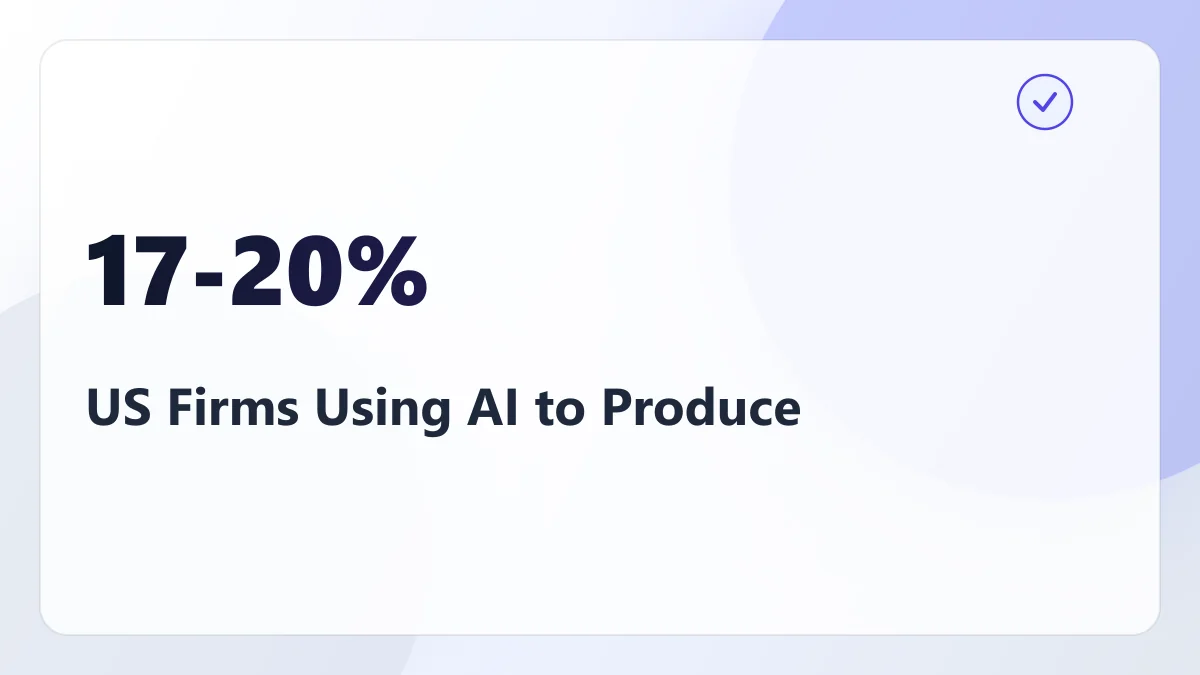
The Census Bureau asks American businesses a narrow question every two weeks: are you using artificial intelligence to produce goods or services. Across collections running from December 14, 2025 to May 3, 2026, the answer held between 17% and 20% (US Census Bureau, May 2026).
Not intend to. Not experimenting with. Using, to produce the thing they sell.
The gradient is the finding
Split the same population by headcount and the national average stops being useful.
| Firm size | Share using AI to produce, percent |
|---|---|
| 250 or more employees | 37 |
| 100 to 249 employees | 32 |
| Fewer than 20 employees | under 20 |
All three figures are as of the May 3, 2026 collection (US Census Bureau, May 2026).
A large firm is roughly twice as likely to be using AI in production as a small one. That ratio is doing more work than any headline about adoption rates, because the small end is where most American businesses are, and it is where the readers of a site like this one operate.
What the question actually captures
“Producing goods or services” is a deliberately high bar, and it excludes a lot of real usage.
A solo consultant who drafts with a model, cleans data with one, and never mentions it to a client is doing something the survey may not count and the consultant may not report. So the 17% to 20% band (US Census Bureau, May 2026) is best read as a floor on serious production use, not as a census of everyone who has ever opened a chat window.
It is still the most useful number available, for one reason: it is asked the same way, of the same frame, every fortnight, by an agency with no product to sell. Compare that to the adoption statistics circulating from vendors whose revenue depends on the answer being large.
Where it concentrates
Information leads every sector at 39.7%, followed by finance and insurance at 33.9%, both above the national rate. Retail trade sits near 14%, with about 17% expecting to use AI in the coming six months (US Census Bureau, May 2026).
Now put a second number beside the first. Information employment fell by 23,000 in August (Bureau of Labor Statistics, September 4, 2026).
The sector with the highest AI use rate in the country is also the sector that shed the most payroll last month. That is a real pairing and it is worth stating plainly. It is not evidence that one caused the other, and this data cannot settle that question: the information sector has been contracting through cycles that had nothing to do with AI, and the same firms that adopt earliest are the ones with the budgets to restructure fastest for a dozen other reasons.
What can be said is narrower. If AI-driven displacement were showing up anywhere first, this is the sector where you would look, and the adoption figure tells you the exposure is concentrated rather than general.
Expectation has been running ahead of use, consistently
Over the same period, between 20% and 23% of businesses expected to be using AI within six months (US Census Bureau, May 2026).
Hold those two ranges next to each other. Expected use has sat a few points above current use for months, while current use stayed inside its band. Firms keep forecasting an adoption they have not yet made.
That is not a failure of anything. It is what a slow diffusion looks like from inside: the intention arrives well before the workflow does, and the gap between them persists rather than closing on the schedule anyone announced. We saw the same shape from the labour side in the month AI fell from first to fourth among stated layoff reasons, where the attribution moved far faster than anything underneath it.
What a small operator should take from this
Three things, and none of them is urgency.
The competitive picture is not what the discourse implies. Four in five businesses are not using this in production. If you are a one-person operation already working this way, you are ahead of most firms with a hundred employees, and that is a positioning fact rather than a technology fact.
The size gradient runs in your favour on speed and against you on budget. Nothing stops a solo operator changing a workflow this week. What large firms have is procurement, security review and the ability to absorb a tool that does not pay off. You do not, which makes the discipline of checking what your stack actually returns more important than the discipline of adopting quickly. The SaaS stack ROI calculator is built for exactly that arithmetic.
And the labour signal is sector-specific, not general. If you work in or sell into information, the adoption rate and the payroll direction both point the same way and it is worth planning around. We looked at the length of the resulting gap in the August duration data, and at where the white-collar adjustment is actually running in professional services hiring.
The bottom line
Between 17% and 20% of American businesses use AI to produce what they sell (US Census Bureau, May 2026). Large firms do it at roughly twice the rate of small ones. Information leads the sectors and is also cutting the most jobs, and the honest version of that sentence stops before the word “because”.
The useful move is to stop reading adoption headlines as a description of your competition and start reading the size gradient as a description of your advantage. Most of the market has not done this yet. That is a fact you can act on for as long as it stays true, and the Census Bureau will keep telling you, for free, every two weeks, exactly how long that is.
